
Augmented NAC: The Complete Guide to N-Acetylcysteine

NAC is one of those supplements that sounds like a passing trend until you look at its history. Hospitals have used it for more than half a century. It's on the World Health Organization's list of essential medicines. And there are now thousands of published studies on it.
It's also become one of the most talked-about supplements around, and not all of that talk is accurate. So here's a plain guide: what NAC is, what the research genuinely shows, where it's still thin, and how to take it well.
What NAC Actually Is
N-acetylcysteine, or NAC, is a slightly modified form of cysteine, an amino acid found in protein foods like eggs, poultry and legumes. On its own that sounds unremarkable. What makes it matter is what your body does with it.
Cysteine is the scarce ingredient your cells need to make glutathione. Glutathione is the main antioxidant working inside your cells, mopping up free radicals, helping the liver process what you eat, drink and breathe in, and keeping cells resilient under stress. When glutathione runs low, NAC gives your body what it needs to rebuild it.
That's exactly why emergency departments use it for paracetamol overdose. A large dose of paracetamol strips the liver of glutathione, and NAC restores it. Doctors have also long used it to thin thick mucus in the lungs.
Why "Augmented" Matters: The Absorption Problem
Here's something most NAC labels won't tell you. Ordinary NAC is poorly absorbed. In a classic pharmacokinetic study, only about 4 to 9% of an oral dose reached the bloodstream (Olsson et al., 1988). The rest is broken down in the gut and liver before it gets far.
Augmented NAC is made using a specialised Italian process developed by B.A.I. Technologies, designed to improve the stability and absorption of NAC so it works at a lower dose. That's why each capsule holds 200 mg and the label suggests two a day, rather than the 1,200 mg or more you'll see on many standard products.
I'll be straight with you: there's no published head-to-head study yet giving an exact conversion between Augmented NAC and regular NAC. So when you read a study that used a large dose of ordinary NAC, don't copy that number. Work out what suits you with your practitioner.

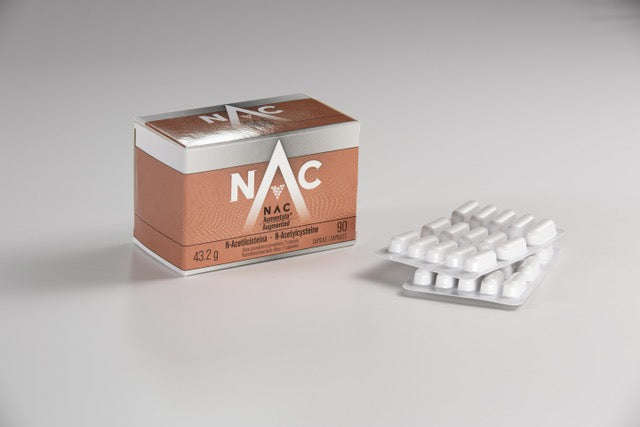
A few practical details. Whichever pack you buy, the NAC itself is made in Italy using the B.A.I. Technologies process. For Australian customers, it's also encapsulated in Italy in a GMP-certified facility and comes in a carton with blister-packed capsules. For customers in the USA and Canada, the same Italian-made NAC is encapsulated and packed into a glass bottle in the USA, under licence from B.A.I. Technologies. It's gluten-free, lactose-free and suitable for vegetarians and vegans.
What the Research Shows
Lungs and Breathing
This is NAC's best-established territory. It breaks apart the bonds that make mucus thick and sticky, so it's easier to clear. In people with chronic obstructive pulmonary disease (COPD), a 2017 analysis of trials found that 1,200 mg a day of NAC significantly reduced flare-ups compared with placebo, while 600 mg a day didn't (Cazzola et al., 2017). A related review noted that 600 mg a day was enough to help in chronic bronchitis (Matera et al., 2016).
Liver and Glutathione
The liver is where glutathione does some of its heaviest lifting, and where NAC's role is best documented. A thoughtful 2014 review made a point I think is important. NAC isn't a powerful antioxidant in its own right. Its strength is topping up glutathione in cells that are running low (Rushworth & Megson, 2014). Put simply, it helps most where the need is greatest.
Brain and Mood
This is the area that has researchers most excited right now. NAC influences glutamate, one of the brain's main chemical messengers, as well as oxidative stress and inflammation in brain tissue. A systematic review of clinical trials found favourable evidence across several mental health and neurological conditions, with others still at an early stage (Deepmala et al., 2015). The authors were clear that bigger, well-designed trials are needed, and so am I.
Gut and Biofilms
Some bacteria protect themselves by forming biofilms, sticky shields that make them hard to shift. A systematic review found NAC helped break down these biofilms and let antibiotics reach deeper layers, as an add-on to standard treatment (Dinicola et al., 2014). It's an interesting area, though most of the work involves infections rather than everyday gut health.
Women's Health
NAC's anti-inflammatory and antioxidant actions have also been studied in endometriosis, with some encouraging early results. I've covered that research in detail in Augmented NAC, OSKA Pulse and Endometriosis.
An Honest Word
NAC isn't a cure-all, whatever you read online. The strongest evidence sits with lung health and with replenishing glutathione when it's depleted. Much of the rest is promising but still developing. I'd rather you start NAC with realistic expectations and stick with it than expect a miracle in a week.
What I do like about NAC is its track record. It's been used for decades, it's well understood, and it's generally well tolerated.
How to Take Augmented NAC
The label suggests two capsules a day, taken with water, ideally 15 to 30 minutes before a meal. Use it consistently for a three-month cycle. Glutathione support builds over time rather than working overnight, so taking it every day matters more than taking a lot.
Some people notice mild tummy upset at first. If that happens, taking it with food usually settles it.
Who Should Check First
Talk to your doctor or pharmacist before starting NAC if you:
- are pregnant or breastfeeding
- have asthma
- take blood-thinning medication such as warfarin, or have a bleeding disorder
- are managing a diagnosed health condition or taking any regular medication
You'll find Augmented NAC, with full product details and directions, in the iSage Health shop.
Julyet, iSage Health
Healing with Tradition, Science & Wisdom
This article is general information only and is not medical advice. Always read the label and follow the directions for use. Speak with your healthcare practitioner before starting NAC, particularly if you are pregnant, breastfeeding, taking medication or managing a health condition.
References
- Olsson B, Johansson M, Gabrielsson J, Bolme P. Pharmacokinetics and bioavailability of reduced and oxidized N-acetylcysteine. Eur J Clin Pharmacol. 1988;34(1):77-82. doi:10.1007/BF01061422
- Cazzola M, Rogliani P, Calzetta L, Hanania NA, Matera MG. Impact of mucolytic agents on COPD exacerbations: a pair-wise and network meta-analysis. COPD. 2017;14(5):552-563. doi:10.1080/15412555.2017.1347918
- Matera MG, Calzetta L, Cazzola M. Oxidation pathway and exacerbations in COPD: the role of NAC. Expert Rev Respir Med. 2016;10(1):89-97. doi:10.1586/17476348.2016.1121105
- Rushworth GF, Megson IL. Existing and potential therapeutic uses for N-acetylcysteine: the need for conversion to intracellular glutathione for antioxidant benefits. Pharmacol Ther. 2014;141(2):150-159. doi:10.1016/j.pharmthera.2013.09.006
- Deepmala, Slattery J, Kumar N, et al. Clinical trials of N-acetylcysteine in psychiatry and neurology: a systematic review. Neurosci Biobehav Rev. 2015;55:294-321. doi:10.1016/j.neubiorev.2015.04.015
- Dinicola S, De Grazia S, Carlomagno G, Pintucci JP. N-acetylcysteine as powerful molecule to destroy bacterial biofilms: a systematic review. Eur Rev Med Pharmacol Sci. 2014;18(19):2942-2948.
Follow iSage Health