Augmented NAC, OSKA Pulse and Endometriosis

Endometriosis affects around one in ten women of reproductive age. That's roughly 190 million women and girls worldwide, according to the World Health Organization. And many of them wait somewhere between four and twelve years for a diagnosis.
The symptoms are familiar. Periods that floor you. Pain during sex. A dull ache in the pelvis that never quite leaves. And too often, years of being told it's “just a bad period” before anyone takes it seriously.
Here's the part that doesn't get talked about enough. Endometriosis isn't only a hormone problem. It's an inflammatory condition, and the tissue involved runs on oxidative stress. Free radicals, inflammatory signals and iron from old bleeding all feed the cycle.
That's exactly why two things have caught my attention. One is N-acetylcysteine (NAC), a simple antioxidant amino acid with some genuinely interesting research behind it. The other is OSKA Pulse, a wearable pulsed electromagnetic field (PEMF) device that a German health insurer has now built into an endometriosis care program. I'll walk you through both, including where the evidence is strong and where it isn't.
What NAC Is, and Why Researchers Looked at It for Endometriosis
NAC is a slightly modified form of cysteine, an amino acid you get from protein foods. Your body uses it to make glutathione, the main antioxidant inside your cells. Hospitals have used it for decades, for paracetamol overdose and to thin mucus in the lungs. So it's not new, and it's not exotic.
What makes it interesting for endometriosis is what happens in the lab.
Endometriosis cells carry unusually high levels of reactive oxygen species. In a 2009 study, a French team showed these cells use that oxidative load as a growth signal, through a pathway called ERK. When they added NAC, lesion growth was blocked, both in the dish and in mice (Ngô et al., 2009).
Other animal work points the same way:
- In mice, NAC reduced the growth, invasiveness and inflammation of endometriosis lesions, without harming fertility (Pittaluga et al., 2010).
- In rats, NAC shrank implants and lowered the inflammatory marker TNF-α, and did so more than leuprolide, a standard hormonal drug (Onalan et al., 2013).
- NAC quietened oxidation-driven pain signalling in an endometriosis model (Ray et al., 2015).
- It partly protected egg cells from damage caused by follicular fluid taken from women with endometriosis (Giorgi et al., 2015).
I like that last one. Fertility is often the quiet worry sitting underneath everything else, and it's good to see research that takes it seriously.
What appeals to me as a practitioner is that NAC doesn't switch off your hormones. It works on the inflammatory, oxidative side of the problem, which is the side most treatments ignore.
What Happened When Women Actually Took It
The study most people quote came out of Sapienza University in Rome in 2013. Porpora and colleagues followed 92 women with ovarian endometriomas, the “chocolate cysts” that form on the ovaries. Half took NAC, half didn't.
After three months the NAC group's cysts had shrunk slightly, by an average of 1.5 mm. In the women who took nothing, they'd grown by 6.6 mm. That's a modest number on paper. What got attention was this: 24 women in the NAC group cancelled their planned keyhole surgery, because their cysts had shrunk or vanished, their pain had eased, or they'd fallen pregnant. Only one woman in the untreated group did the same.
The same Rome group came back in 2023 with 120 women on the same regimen (Anastasi et al.). Period pain, pain during sex and general pelvic pain all improved significantly over three months. Women needed fewer anti-inflammatory painkillers. Cyst size and CA-125, a blood marker linked to endometriosis, both came down. Of the 52 women trying to conceive, 39 were pregnant within six months.
That pregnancy figure is striking. I'd still read it with a bit of caution, which I'll come to.
A few other studies are worth knowing about:
- Women going through IVF/ICSI. A 2026 randomised trial of 60 women with endometriosis gave 1.8 to 3 g of NAC a day for six weeks. Blood levels of lead and nickel dropped, as did total cholesterol and triglycerides (Khorasani et al., 2026).
- NAC with alpha-lipoic acid and bromelain. The LEAP study followed 398 women for six months. Pelvic pain and the need for rescue painkillers improved modestly (Lete et al., 2018).
- NAC with quercetin and curcumin. A small two-month study of 33 women found pain and painkiller use both fell significantly (Fadin et al., 2020).
The most up-to-date overview is a 2026 systematic review pulling together 22 studies (Watrowski et al., 2026). Outside the after-surgery setting, NAC was linked with less pain, less need for anti-inflammatories, and cysts that shrank or at least stopped growing.
Being Honest About the Evidence
Most of the positive human data comes from one research group in Rome, and most of it is uncontrolled. There's still no placebo-controlled trial of NAC on its own for endometriosis pain or cyst size. The 2023 study had no comparison group at all, so we can't be sure how much of that improvement was NAC and how much was time, attention or other changes.
The one randomised trial looking at recurrence after surgery was a disappointment. Asgari and colleagues (2022) gave 100 women either a low-dose contraceptive pill alone or the pill plus NAC. At six months, adding NAC made no extra difference to cyst recurrence or pain.
The combination studies are hard to pin on NAC, because they mix several ingredients. One was small and had industry links.
So where does that leave us? The 2026 review put it well. The biology is strong, the clinical evidence is limited and patchy, and the fertility findings are promising but early. Bigger, better trials are needed.
Still, I find this one of the more encouraging stories in natural medicine for endometriosis. NAC is inexpensive, well understood and generally well tolerated. The signals keep pointing the same way.
How It Was Taken in the Studies
The Rome protocol, the one with the most data behind it, used 600 mg three times a day, on three consecutive days each week, for three months. That's 1.8 g on each “on” day, then four days off.
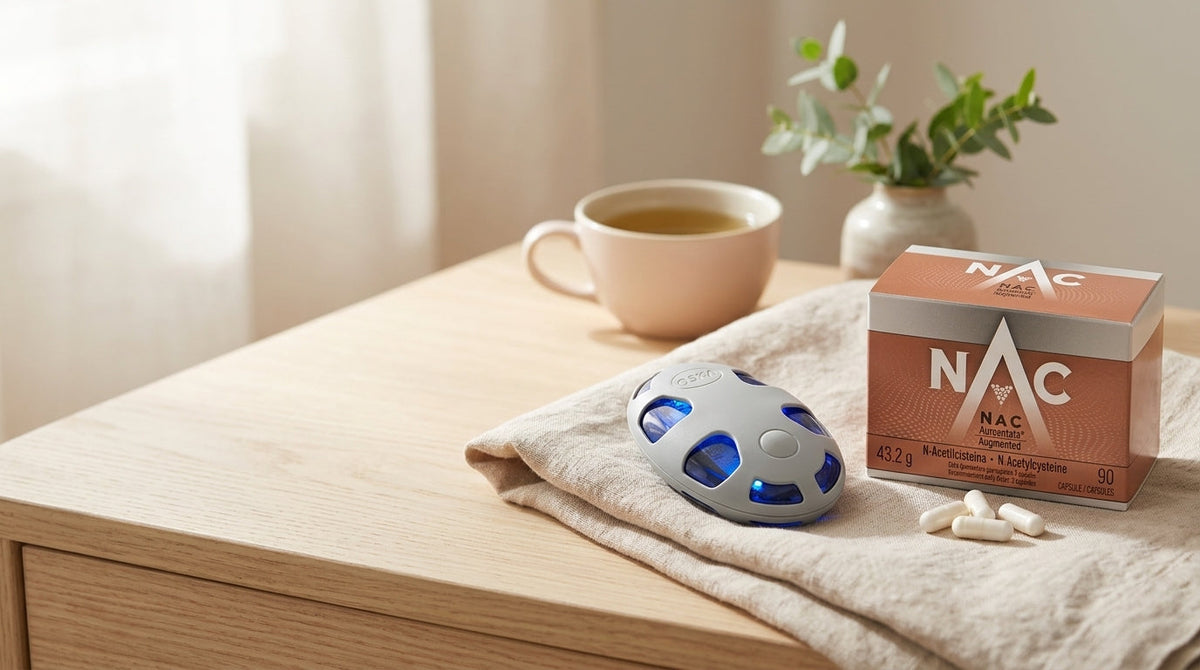
Those studies all used regular NAC, and regular NAC is poorly absorbed. In a classic pharmacokinetic study, only about 4 to 9% of an oral dose reached the bloodstream (Olsson et al., 1988). Augmented NAC is made with a specialised Italian process from B.A.I. Technologies, designed to improve the stability and absorption of NAC so it works at a lower dose. That's why its label suggests two 200 mg capsules a day (400 mg), well below the 1.8 g used on the “on” days in the Rome studies.
So the study doses don't translate one-for-one, and you'd generally need less Augmented NAC than the research amounts. There's no published head-to-head study yet giving an exact conversion, so please work out your dose with your practitioner rather than copying a study.
OSKA Pulse: A Drug-Free Option for Pelvic Pain
NAC works on the biology over weeks and months. Pain, though, doesn't wait. That's where I think PEMF earns a place in the conversation.
Pulsed electromagnetic field therapy sends gentle magnetic pulses into the tissue. It's thought to calm inflammation and improve local circulation. It has decent trial evidence behind it for several chronic pain conditions, including low back pain, osteoarthritis and fibromyalgia.
OSKA Pulse is a small, wearable PEMF device. You don't need it touching your skin, so it can sit over clothing on the lower abdomen or lower back while you get on with your day. No pills, no needles.
A German Health Insurer Is Now Funding It for Endometriosis
This is the news that made me sit up. BARMER, one of Germany's largest public health insurers, has launched a program called ENDOPOWER for women with endometriosis or adenomyosis. It was developed with University Hospital Cologne, Electro-Zeutika GmbH and specialist gynaecology practices.
Eligible women aged 18 and over in North Rhine-Westphalia get 12 months of coordinated support. It starts with a full consultation covering medical, psychological and social needs. Depending on the person, the program can include education, symptom diaries, digital support, specialist appointments and surgical review where it's clinically needed.
And it includes OSKA Pulse, worn in daily life for up to a year, with BARMER covering the cost alongside regular counselling.
BARMER describes the program as an alternative to heavy medication or repeated surgery. OSKA's own team stresses that endometriosis is different for every woman, which is why a flexible, multi-pronged approach makes sense. I couldn't agree more.
To be clear, ENDOPOWER is a care program, not a clinical trial. The press release doesn't report outcome results. But a public insurer choosing to pay for a device for a full year tells you something.
What the Research on PEMF and Pelvic Pain Shows
The PEMF research in this area is small, but it's growing:
- Endometriosis pain. A 2023 pilot combined PEMF with ozone sauna therapy in women with endometriosis. Pain scores improved significantly after the fourth session, and the inflammatory markers CRP and IL-1β dropped (Merhi et al., 2023). It's a tiny study and a combination treatment, so PEMF can't take all the credit.
- Period pain. In a randomised trial of 52 young women with primary dysmenorrhoea, PEMF significantly reduced pain and lowered blood levels of prostaglandins, the chemicals behind period cramps (Thabet et al., 2017). High-intensity laser did a bit better, but both worked.
- Chronic pelvic pain. In women with bladder pain syndrome, seven of eight who finished four weeks of PEMF had a meaningful drop in pelvic pain, with no side effects reported (Wolff et al., 2022).
- Gynaecological pain more broadly. An older report found 18 of 20 episodes of pelvic pain, including endometriosis and period pain, improved markedly with short PEMF treatments (Jorgensen et al., 1994).
There's also a proper randomised, sham-controlled trial of PEMF for endometriosis now recruiting at Beni-Suef University in Egypt. It's measuring pain, quality of life and pelvic floor changes over eight weeks, with results due in 2027. I'll be watching for it.
OSKA Pulse isn't intended to diagnose, cure or prevent any disease. Where I see it fitting is pain support, alongside whatever care you and your doctor have in place.
Using Them Together
I like these two side by side because they work on different timelines. NAC targets the oxidative stress and inflammation that drive the condition, and the studies ran for three months. OSKA Pulse is there for the day-to-day pain while you wait for that slower work to happen.
Neither replaces your gynaecologist. Think of them as part of a bigger picture that might also include diet, gut health, stress, pelvic floor physio and, for some women, surgery or hormonal treatment. ENDOPOWER itself is built on that idea.
Who Should Check First
Talk to your doctor before starting NAC if you're pregnant or breastfeeding, have asthma, or are going through IVF. Some people get mild tummy upset, which usually settles if you take it with food.
PEMF devices aren't suitable if you have a pacemaker or other implanted electronic device, or if you're pregnant. Check the OSKA instructions for the full list.
Where to Find Them
- Augmented NAC, 200 mg, 90 capsules. Made in Italy, and the one I trust.
- OSKA Pulse PEMF device. I'm an authorised OSKA agent, so if you'd like to talk through whether it suits you, get in touch.
Julyet, iSage Health
Healing with Tradition, Science & Wisdom
This article is for general information only and isn't medical advice. Please speak with your doctor or a qualified health practitioner before starting any supplement or device, especially if you have a diagnosed condition, take medication, or are pregnant or trying to conceive.
References
NAC: Human Studies
- Porpora MG, Brunelli R, Costa G, et al. A promise in the treatment of endometriosis: an observational cohort study on ovarian endometrioma reduction by N-acetylcysteine. Evid Based Complement Alternat Med. 2013;2013:240702. doi:10.1155/2013/240702
- Anastasi E, Scaramuzzino S, Viscardi MF, et al. Efficacy of N-acetylcysteine on endometriosis-related pain, size reduction of ovarian endometriomas, and fertility outcomes. Int J Environ Res Public Health. 2023;20(6):4686. doi:10.3390/ijerph20064686
- Asgari Z, et al. Adjunctive N-acetylcysteine with a low-dose contraceptive after laparoscopic surgery for ovarian endometrioma: a randomised clinical trial. J Obstet Gynaecol. 2022. doi:10.1080/01443615.2021.2006165
- Khorasani, et al. N-acetylcysteine in women with endometriosis undergoing ICSI: a randomised controlled trial. Health Sci Rep. 2026. doi:10.1002/hsr2.73026
- Lete I, Mendoza N, de la Viuda E, Carmona F. Effectiveness of an antioxidant preparation with N-acetyl cysteine, alpha lipoic acid and bromelain in the treatment of endometriosis-associated pelvic pain: LEAP study. Eur J Obstet Gynecol Reprod Biol. 2018;228:221-224. doi:10.1016/j.ejogrb.2018.07.002
- Fadin M, et al. Effectiveness of the integration of quercetin, turmeric and N-acetylcysteine in reducing inflammation and pain associated with endometriosis. Minerva Ginecol. 2020. doi:10.23736/S0026-4784.20.04615-8
- Watrowski R, et al. N-acetylcysteine in endometriosis: a systematic review. Antioxidants. 2026;15(7):880. doi:10.3390/antiox15070880
NAC: Laboratory and Animal Studies
- Ngô C, Chéreau C, Nicco C, Weill B, Chapron C, Batteux F. Reactive oxygen species controls endometriosis progression. Am J Pathol. 2009;175(1):225-234. doi:10.2353/ajpath.2009.080804
- Pittaluga E, Costa G, Krasnowska E, et al. More than antioxidant: N-acetyl-L-cysteine in a murine model of endometriosis. Fertil Steril. 2010;94(7):2905-2908. doi:10.1016/j.fertnstert.2010.06.038
- Onalan G, et al. Arch Gynecol Obstet. 2013. doi:10.1007/s00404-013-2963-0
- Ray K, et al. Oxidation-sensitive nociception involved in endometriosis-associated pain. Pain. 2015;156(3):528-539. doi:10.1097/01.j.pain.0000460321.72396.88
- Giorgi VS, Da Broi MG, Paz CC, Ferriani RA, Navarro PA. N-acetyl-cysteine and L-carnitine prevent meiotic oocyte damage induced by follicular fluid from infertile women with mild endometriosis. Reprod Sci. 2016;23(3):342-351. doi:10.1177/1933719115602772
NAC: Absorption
- Olsson B, Johansson M, Gabrielsson J, Bolme P. Pharmacokinetics and bioavailability of reduced and oxidized N-acetylcysteine. Eur J Clin Pharmacol. 1988;34(1):77-82. doi:10.1007/BF01061422
PEMF and OSKA Pulse
- OSKA, BARMER, Electro-Zeutika GmbH. ENDOPOWER program press release: OSKA Pulse included in BARMER endometriosis care program. OSKA press release (PDF)
- Merhi Z, Emdin D, Bosman L, Incledon T, Smith AH. Ozone sauna therapy (OST) and pulsed electromagnetic field therapy (PEMF) delivered via the HOCATT machine could improve endometriosis pain along with lowering serum inflammatory markers. Am J Reprod Immunol. 2023;89(4):e13690. doi:10.1111/aji.13690
- Thabet AAE, Elsodany AM, Battecha KH, Alshehri MA, Refaat B. High-intensity laser therapy versus pulsed electromagnetic field in the treatment of primary dysmenorrhea. J Phys Ther Sci. 2017;29(10):1742-1748. doi:10.1589/jpts.29.1742
- Wolff DT, Ross C, Lee P, et al. Pulsed electromagnetic field therapy for pain management in interstitial cystitis/bladder pain syndrome: a proof-of-concept case series. Urology. 2022;167:96-101. doi:10.1016/j.urology.2022.05.021
- Ross C, Overholt T, Xu R, et al. Pulsed electromagnetic field (PEMF) as an adjunct therapy for pain management in interstitial cystitis/bladder pain syndrome. Int Urogynecol J. 2022;33(3):487-491. doi:10.1007/s00192-021-04862-3
- Jorgensen WA, Frome BM, Wallach C. Electrochemical therapy of pelvic pain: effects of pulsed electromagnetic fields (PEMF) on tissue trauma. Eur J Surg Suppl. 1994;(574):83-86.
- Beni-Suef University. Efficacy of pulsed electromagnetic field therapy on women with endometriosis: a randomized controlled trial. ClinicalTrials.gov NCT07592403. clinicaltrials.gov/study/NCT07592403
Follow iSage Health